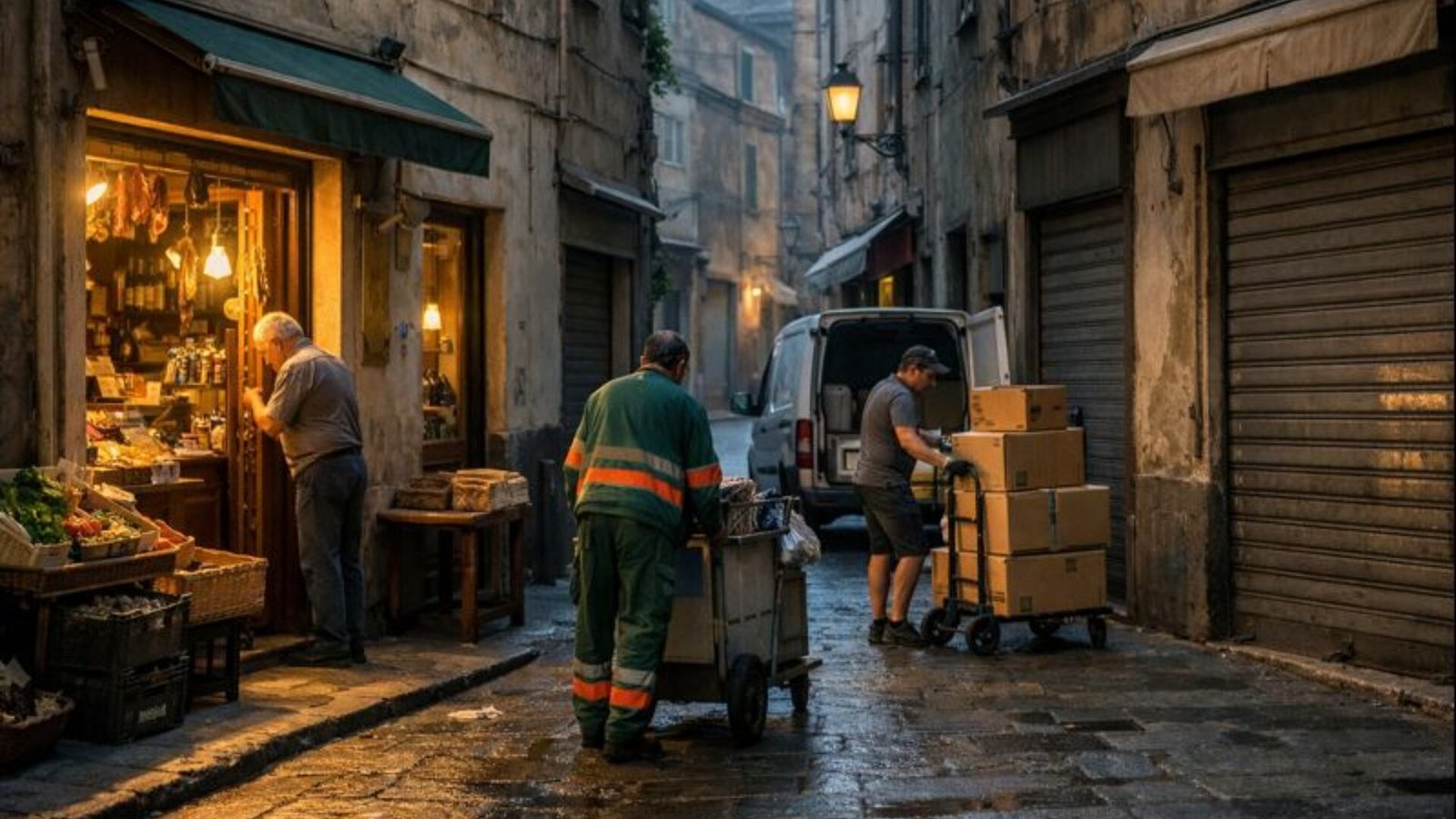
Modern Italy no longer follows a linear path in which education is completed first, followed by stable employment and gradual economic security. That model, once reliable for generations, has steadily lost its relevance. Today, the labor market is fragmented, living costs rise faster than incomes, and long-term guarantees are increasingly rare. In this context, education, work, and business are no longer separate stages of life but interconnected elements of a single system. People study while working, work without long-term security, and turn to business as a way to maintain control over income and personal autonomy. This is not a theoretical framework, but a concrete reality shaping everyday life across Italy.
Education in Italy: Learning as a Continuous Process
Education has always held a central role in Italian society. Historic universities, strong academic traditions, and the belief that formal education leads to stability have shaped expectations for decades. For a long time, earning a degree significantly increased the chances of finding secure employment and building a predictable future. That direct connection has largely disappeared.
One of the structural weaknesses of the Italian education system is the gap between theoretical instruction and real labor market needs. Many academic programs provide strong conceptual knowledge but fail to prepare students for practical requirements such as digital tools, operational responsibilities, and fast-paced working environments. As a result, graduates often face long transitional periods marked by internships, short-term contracts, or inactivity.
Regional disparities intensify the issue. In Northern Italy, job opportunities are more abundant, but competition is intense and the cost of living significantly reduces real income. In the South, limited employment options push many people to migrate or seek alternative economic paths. In both cases, education no longer guarantees employment; it merely provides a starting foundation.
Within this environment, the meaning of education changes. Learning is no longer confined to early adulthood but becomes a continuous process. Professional training programs, online courses, certifications, self-directed learning, and digital skill development are now part of everyday life. Studying while working is no longer exceptional—it is necessary.
An increasing number of people in Italy return to education after the age of 30 or 40. Economic restructuring, automation, and company closures force workers to retrain and adapt. In many cases, this learning is self-funded and demands significant personal investment. Responsibility for professional development shifts away from institutions and onto individuals.
Ultimately, education in Italy is no longer a preliminary phase but the foundation of economic survival. Without continuous skill development, it becomes difficult to remain employed, change sectors, or build independent economic activity. Lifelong learning is no longer optional; it is structural.
Work in Italy: Between Precariousness and Adaptation
For decades, work in Italy was associated with permanent employment, long-term contracts, and predictable career paths. That model has eroded. Today, the labor market is dominated by fixed-term contracts, part-time work, project-based roles, and temporary collaborations. Stability has become the exception rather than the rule.
This shift profoundly alters how work is experienced. Employment is no longer defined by long-term attachment to a single organization but by fragmented professional experiences. Careers unfold through discontinuous phases that require constant renegotiation and adaptation.

A key element of this system is the widespread use of individual tax identification numbers for professional or commercial activity. It is essential to clarify that this is not a form of employment, nor does it define the nature of the working relationship. It is a fiscal mechanism used to report income and manage taxes and social contributions.
In practice, this mechanism is frequently used to structure work that closely resembles dependent employment. Individuals may work continuously for a single client, follow schedules, and meet fixed obligations, while lacking paid leave, sick pay, or employment protections. Economic and social risks are transferred entirely to the individual.
This arrangement increases uncertainty. Without income continuity or social safeguards, long-term planning becomes difficult. In major Italian cities, where housing and living costs are high, work often provides short-term survival rather than long-term security.
At the same time, new opportunities are emerging. Remote work, digital professions, and international collaboration allow many Italians to access broader markets. These opportunities, however, require advanced skills and continuous learning, reinforcing the connection between education and work.
In summary, work in Italy is no longer synonymous with security. It is a dynamic process that generates experience and competence but rarely stability. Work becomes a transitional phase within a broader adaptive system.
Business in Italy: A Tool for Economic Balance
Within an unstable labor environment, many people in Italy turn to business not as an ideological ambition but as a practical response. Business is not seen as a promise of rapid growth but as a way to regain control over income and personal organization.
Italy’s economy has long been built on small and micro-scale enterprises. Family-run activities, local services, and individual operations form the backbone of the productive system. Today, this structure evolves through digital tools, online platforms, and flexible operational models.

Many modern businesses are centered on a single individual. Consulting, digital services, online commerce, content production, and localized activities allow people to operate without complex organizational structures. This reduces overhead but increases personal responsibility.
Digital infrastructure plays a decisive role. Online platforms remove geographic barriers and provide access to national and international markets. In a country marked by strong regional inequalities, this represents a crucial balancing mechanism.
Business in Italy, however, remains shaped by bureaucracy, regulatory complexity, and tax pressure. As a result, entrepreneurship is often oriented toward sustainability rather than aggressive expansion. Continuity and control matter more than scale.
Business does not emerge in isolation. It grows out of skills developed through education and experience gained through work. In this sense, business completes the cycle while simultaneously reopening it, as it requires ongoing learning and adaptation.
In today’s Italy, education, work, and business are not sequential steps but interconnected components of a single system. Understanding this relationship is essential to understanding contemporary Italian economic life—one built not on certainty, but on balance, adaptation, and continuity.