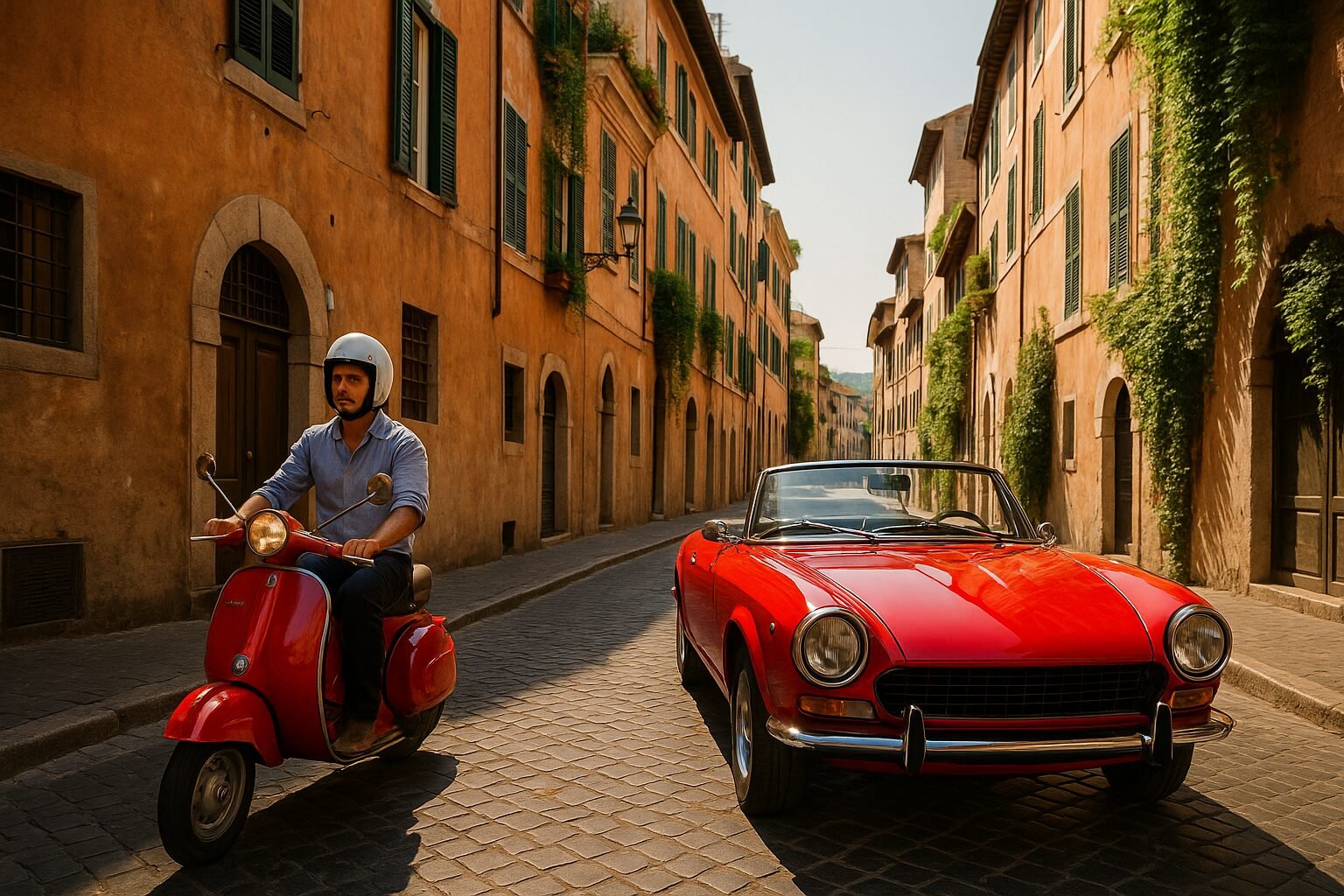
In Italy, a car is never a neutral decision. It speaks before the driver does, tells a story without words, and sometimes even betrays its owner’s intentions. From the choice of car, people read character, background, attitude toward life, and, more deeply, toward the country itself. That is why asking why Italian cars are the best in Italy is not a technical discussion about horsepower or reliability charts. It is a cultural question. In a country where every street has memory and every gesture carries meaning, the car becomes part of the national language. And in Italy, that language is understood instantly.
Italian Cars as a Reflection of Culture and National Character
Italy has never built cars detached from real life. Unlike countries where the automotive industry developed primarily as a matter of engineering discipline, Italian cars were shaped inside a loud, emotional, contradictory society. They were not designed to dominate space, but to live within it.
Italian cities existed long before cars. Narrow historic streets, irregular layouts, crowded squares, hills and endless curves forced a specific mindset: adapt the car to the environment, not the other way around. This created a tradition of compact dimensions, responsive steering, and a direct physical connection between driver and machine. Italian cars are not meant to overpower the road; they negotiate with it.

Design in Italy is never decoration. It is a way of thinking. A car must have a face, an expression, a temperament. Anonymity is perceived as emptiness. Even the simplest model is expected to communicate something, because the car is seen as an extension of the body and personality of the driver. That is why Italian cars do not aim for sterile perfection — they aim for recognizability.
Equally important is Italy’s relationship with imperfection. Italian culture does not reject flaws; it absorbs them. A quirk becomes character, a weakness becomes personality. Italian cars can be demanding, sometimes stubborn, occasionally illogical — but if they deliver emotion, they are forgiven. Cold precision without feeling is far less appreciated.
Driving in Italy is a physical experience. The car must respond, resist slightly, speak back. A vehicle that is too silent, too neutral, too “correct” feels suspicious. It seems distant, foreign, like someone speaking flawless grammar with no accent in a country built on inflection. Italian cars always speak — sometimes loudly, sometimes passionately, but never silently.
This is why Italian cars are considered the best in Italy: not because they are perfect, but because they align with the country’s cultural code. They do not need explanations. They simply belong.
Why Italian Cars Work Better Specifically in Italy
Italy is a challenging country for any automobile. There is no single rhythm. North and South follow different logics, cities change character within minutes, and roads shift from order to chaos without warning. In such conditions, the ideal car is not the most powerful or the most advanced, but the most adaptable.
Italian cars were created precisely for this uneven reality. Their steering response, suspension tuning, and overall behavior are not theoretical simulations but the result of decades of coexistence with real Italian infrastructure. Tight turns, unpredictable traffic, impossible parking — these are not edge cases but daily conditions.

Climate also matters. Intense heat, humidity, sea air, dust, sudden temperature changes between plains and mountains — Italian cars are accustomed to all of this. They were designed without assuming ideal environments. This produces a kind of reliability that is less visible on paper but deeply felt in everyday use.
There is also the practical aspect of ownership. In Italy, an Italian car is understood. Mechanics know it, spare parts are accessible, and the market is familiar with its logic. This reduces friction between owner and machine. The car becomes routine rather than a constant source of stress.
Foreign cars, even excellent ones, often feel out of place. They may be technologically superior or objectively refined, but their logic was developed for different roads, different habits, different expectations. What works perfectly elsewhere can feel excessive, rigid, or awkward in Italian daily life.
Italian cars succeed not because they win every technical comparison, but because they fit. And in Italy, fitting the environment matters more than abstract perfection.
Social Perception and the Car as a Sign of Belonging
In Italy, a car is a social signal. It is read instantly, often subconsciously. An Italian car appears natural, almost invisible in its coherence. A European car is seen as a deliberate step aside. Not a scandal — a gesture.
Choosing a European car often triggers mild irony. It feels like speaking your native language with a slight foreign accent. Not wrong, but noticeable. A symbolic distancing from the shared context.

But the real rupture begins with Chinese cars. At this point, taste or budget no longer matter. A social automatism takes over. In Italy, these vehicles are strongly associated with the large and visible Chinese community. The image is established and operates without reflection.
When an Italian is behind the wheel of a Chinese car, a perceptual short circuit occurs. Everything is Italian — license plate, gestures, driving style — yet the car speaks another language. The result is both funny and sad. Funny because of the absurdity. Sad because character disappears.
In Italy, the flaws of Italian cars are accepted as personality traits. The flaws of foreign cars are seen as mistakes. This distinction is crucial. A domestic car invites dialogue. A foreign one comes with instructions.
And the final conclusion, rarely stated aloud but widely understood, is simple:
a true Italian drives an Italian car.
Not out of obligation, but because anything else, here, inevitably feels un-Italian.