Travel is not only about routes, museums, and postcards. Often, what stays with us are snippets of conversation, awkward pauses, and small scenes experienced at a table in a café or restaurant. Salerno and its surroundings serve as the backdrop for these moments — ordinary on the surface, yet unexpectedly revealing. These stories are not about food as the main attraction, but about people, their attitudes, and the spontaneous reactions that appear when no one is performing a role. They are fragments of real life, quietly observed, turning travel into something more intimate and memorable.

Apricot Sauce
In our restaurant in Salerno, there was a guest who came in every single day.
Not almost every day. Not often. Every day, with a precision that eventually stopped surprising us. In fact, if he didn’t appear at his usual time, someone in the kitchen would start wondering if everything was okay.
He was a tourist from Germany.
The kind who doesn’t try to seem Italian and doesn’t feel the need to explain how much he loves Italy. He didn’t photograph his food, didn’t ask for Wi-Fi, didn’t compare anything to home. He came in, greeted us politely, sat at the same table every time, slightly away from the center of the room, and ordered the same thing.

Pancakes with apricot sauce.
No variations.
No changes.
Sometimes an espresso. Sometimes just still water. That was all.
The dish was served on an almost flat plate, chosen more for aesthetics than convenience. The pancakes were soft and golden, the apricot sauce glossy and fragrant, carefully poured in the center. Simple, clean presentation.
And then the ritual began.
He ate slowly and neatly. Calm, precise movements. He cut the pancakes into even pieces, never rushed, never distracted. He didn’t look at his phone, didn’t watch the room, didn’t seem interested in anything except the plate in front of him.
When he finished the last bite, he didn’t touch the sauce right away.
He paused.
Took a sip of water.
Looked at the plate as if considering something important.
Then he picked up the fork.
Not a spoon.
Always the fork.
With slow, deliberate movements, he began to spread the remaining apricot sauce across the entire plate. From the center outward, along the edges, all the way to the rim. Careful, methodical strokes, as if he were drawing invisible lines.
By the end, the plate was completely covered — a thin, even layer of sauce from edge to edge. Nothing left untouched.
Then he stopped.
Placed the fork down.
Aligned the cutlery neatly.
Leaned back in his chair.
And waited.
He wasn’t waiting for the bill.
He was waiting for the moment.
The moment the server would approach.
The moment a hand would reach out.
The moment someone would pick up that plate.
And he watched closely.
The hands.
The grip.
The reaction.
Some servers hesitated slightly.
Some changed their grip at the last second.
Some pretended not to notice but tensed up.
Some got their hands dirty and sighed.
He never laughed.
Never provoked.
Never seemed openly amused.
He simply observed.
For days, then weeks, no one really understood why. At first we thought it was just a quirk. Then a provocation. Then a quiet cruelty. Someone said it was boredom. Someone said it was a test of service. Someone joked, “That’s how Germans are.”
One day, a new waiter started. Young, calm, not yet hardened by years in the dining room. When he saw the plate, he didn’t hesitate. He didn’t grab it by the edge. He didn’t tilt it.
He picked it up from underneath, with both hands.
Calmly.
Naturally.
The sauce didn’t drip.
His hands stayed clean.
The gesture was simple and confident.
The German tourist watched him.
And gave a small nod.
No smile.
Just the nod.
The next day, he left double the tip.
That’s when we understood.
It wasn’t mockery.
It wasn’t a habit.
It was a test.
Not of skill.
Not of technique.
But of attitude.
He wanted to see how someone reacts to inconvenience.
To something uncomfortable.
To something that can’t be avoided.
Whether they get irritated.
Whether they tense up.
Whether they complain.
Or whether they simply accept it and move on.
When his vacation ended, he came one last time.
Ordered the pancakes.
Spread the sauce.
Watched the plate being taken away.
He paid.
Left the tip.
And said just one sentence, in clear Italian with a light German accent:
— This is a very calm place.
Then he left.
The flat plates are still there.
And so is the apricot sauce.
The Black Apron Skirt
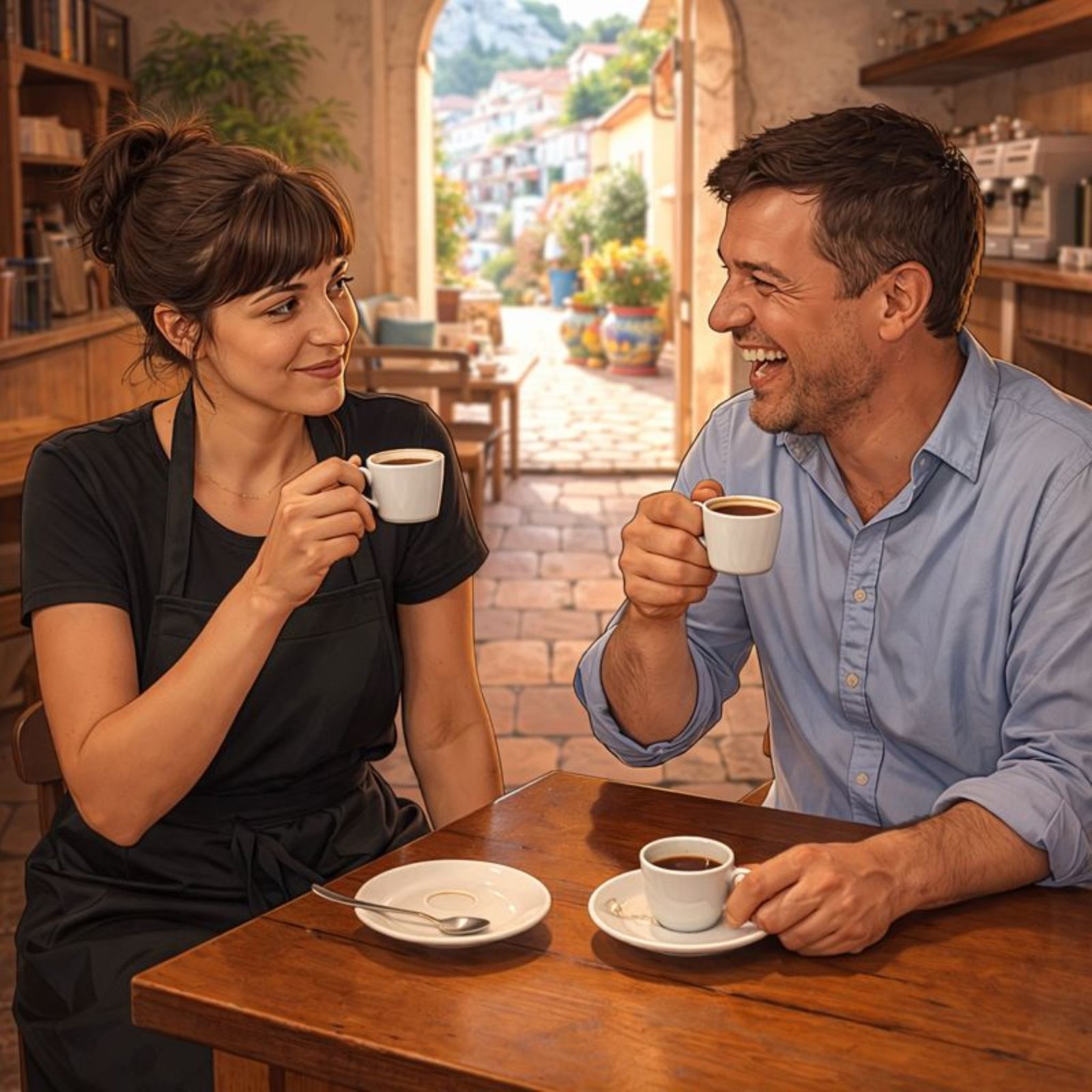
He simply walked into the café.
No rush, no hesitation — the way people enter a place when they’re not looking for anything special, and for that very reason end up finding something unexpected. It was an ordinary day in Vietri sul Mare, a suburb of Salerno, with sunlight reflecting off colorful ceramics and the air filled with the scent of sea and coffee.
I had come there from Naples for just a few days. No plans, no checklist, no urge to “do” anything. Just the need to slow down, to change pace, to sit somewhere without having to explain myself. Vietri was perfect for that: small, bright, calm in a quiet, honest way.

The café was simple and real. A few tables, a coffee machine that had clearly been doing its job for years, and an atmosphere that didn’t need marketing. I wasn’t working there. I had only stepped in for a coffee and a bit of shade.
That day I was wearing a black apron skirt and a plain black T-shirt. Comfortable, practical, thoughtless. An outfit that, in hindsight, said more than it should have. All it lacked was a sign reading staff.
He approached the counter, looked at me with complete confidence, and said:
— An espresso, please.
It took me a moment to realize he was speaking to me.
Then I smiled.
I didn’t correct him. I made the espresso, served it calmly, took a cup for myself… and sat down at his table.
For him, the world stopped.
— You’re having coffee too? — he asked, surprised.
— Yes, — I replied.
A pause.
— Won’t you get in trouble? — he added, lowering his voice with genuine concern.
I looked at him calmly and said:
— No. I just quit.
A silent question appeared in his eyes — big, wordless. You could see him trying to put the picture back together: the café, me, the coffee, the apron skirt, the resignation, the shared table. Nothing fit.
I waited a second.
Then added:
— Because I’m not a waitress.
That’s when he burst out laughing.
Real laughter. Uncontrolled, sincere. He laughed at the situation, at himself, at how naturally he had assigned me a role based solely on what I was wearing.
— I was sure… — he said, wiping his eyes. — You looked exactly like the staff.
— Black clothing is very convincing, — I answered.
We talked. He turned out to be from Modena. We spoke about Naples, Emilia, different rhythms, habits, and the way people see the world through the rules they’re used to. He admitted that it was impossible for him to imagine someone simply offering a stranger a coffee, without a reason, without a role, without expectations.
And yet, that’s exactly what had happened.
Nothing had changed — except perspective.
One outfit, one assumption, one automatic conclusion — and suddenly a person becomes someone else.
When he left, he looked at me one last time and said:
— I’m glad I was wrong.
I stayed there, my empty cup in front of me, thinking about how easy it is to be mistaken for something you’re not.
Sometimes all it takes is a black apron skirt.
Meat with Prunes
We walked into the restaurant without great expectations.
Not because it wasn’t a good place — quite the opposite — but because Amalfi is one of those towns where everything already feels like a promise: the sea below, the stairs, the pale façades, the tourists looking around as if they know they’re somewhere special. And in places like that, food can sometimes end up being just scenery.
We were there almost by accident.
We had come from Trento to Salerno for work — meetings, schedules, obligations. One of those trips where time is neatly divided into blocks. Then, suddenly, a window opened. Not half an hour stolen here and there, but real time. And instead of staying in the city or returning to the hotel, we decided to move, explore the surroundings, breathe something different.

That’s how we ended up in Amalfi.
The restaurant was excellent. Not flashy, not loud, not designed to impress tourists. Solid, calm, confident. Tables well spaced, service unhurried, a menu that didn’t rely on unnecessary words. A place that knew exactly what it was.
We ordered.
And then we waited.
We waited.
And waited some more.
At a certain point, the waiting started to feel long. Not annoying, not frustrating — just longer than expected. In Italy, you’re used to dishes arriving fairly quickly, especially when the order isn’t complicated. We looked around, sipped our water, commented on the place.
Eventually we called the waitress over, calmly, without complaint. Just to understand.
She looked at us as if the answer were obvious and said:
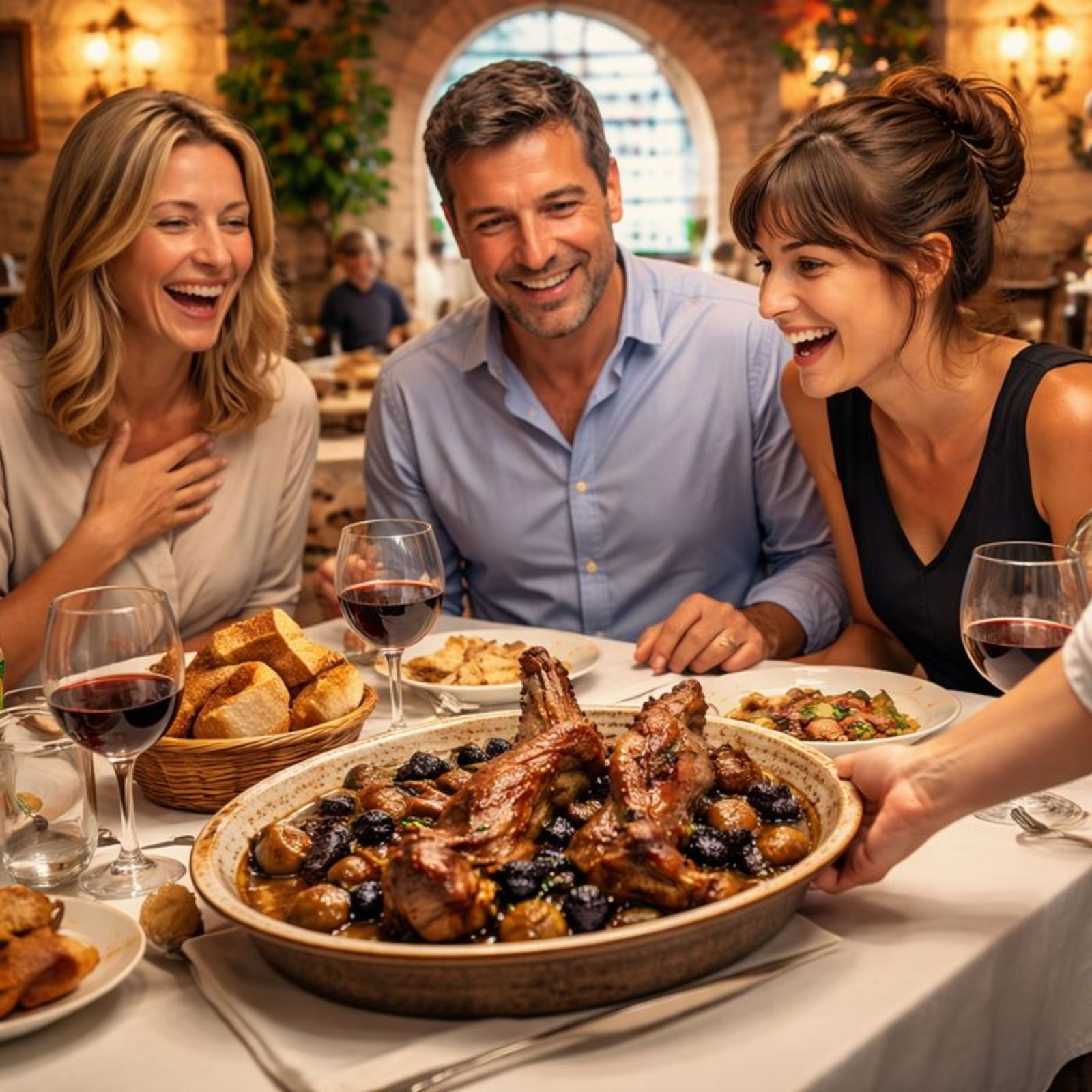
— Your meat with prunes is still cooking.
And that’s when something unexpected happened.
A friend of mine burst out laughing. Not a polite laugh — a real one, sudden and contagious. And she said:
— Ah, now I see! At home, I usually start preparing prunes a day in advance. Are we going to wait that long too?
For a second, the table froze.
The waitress blinked.
So did we.
And at that moment, without any irritation, almost talking to myself, I said:
— I’m starting to think they went to slaughter the lamb just now.
It wasn’t a complaint.
It was an ironic observation.
Because we already knew what we had ordered.
Not generic meat.
Not an abstract “meat with prunes.”
We had ordered lamb with prunes.
We chose it deliberately, reading the menu. And we knew it wasn’t a fast dish. Lamb can’t be rushed. It needs time, patience, slow cooking that allows the prunes to become part of the dish — not a sweet distraction, but depth.
While we waited, everyone around us was eating fish.
Fish everywhere.
Sea bream, calamari, seafood, pasta scented with the sea.
For a brief moment, we wondered if we’d made the wrong choice. Maybe, in a place like this, it would have been more logical to order what everyone else did. But the thought passed quickly. The waiting had already become part of the experience.
When the dish finally arrived, conversation stopped on its own.
It was lamb.
Tender, structured, fragrant. Not dry, not falling apart. The prunes didn’t overpower the flavor — they supported it. The sauce was thick, warm, deep. A dish made with intention, not haste.
We tasted it, and immediately it was clear:
it was worth the wait.
We ate slowly. Not out of politeness, but by choice. Because we wanted to remember the taste, the texture, the exact moment. This was one of those dishes that makes you understand that waiting isn’t just justified — it’s necessary. That dish could not have arrived sooner, and now it was obvious why.
And that’s when we understood everything.
In a town where everyone orders fish, we chose meat.
In a tourist destination, we chose something that wasn’t the obvious choice.
On a work trip, we found a moment of genuine pleasure.
We didn’t regret anything.
Not the time.
Not the jokes.
Not the idea that maybe someone really did go “to get the lamb.”
Amalfi stayed with us not just for the views or the sea.
It stayed for a flavor that refused to rush.
And for lamb with prunes that was worth every minute of waiting.
SALERNO – DOVE SI PUÒ MANGIARE BENE
Here you’ll find reviews, recommendations, and real impressions of restaurants, cafés, and bars in Salerno. People share personal experiences, tips, and discoveries — from small local spots to well-known places truly worth visiting. A space for those who want to eat well and rely on genuine opinions rather than advertising.